
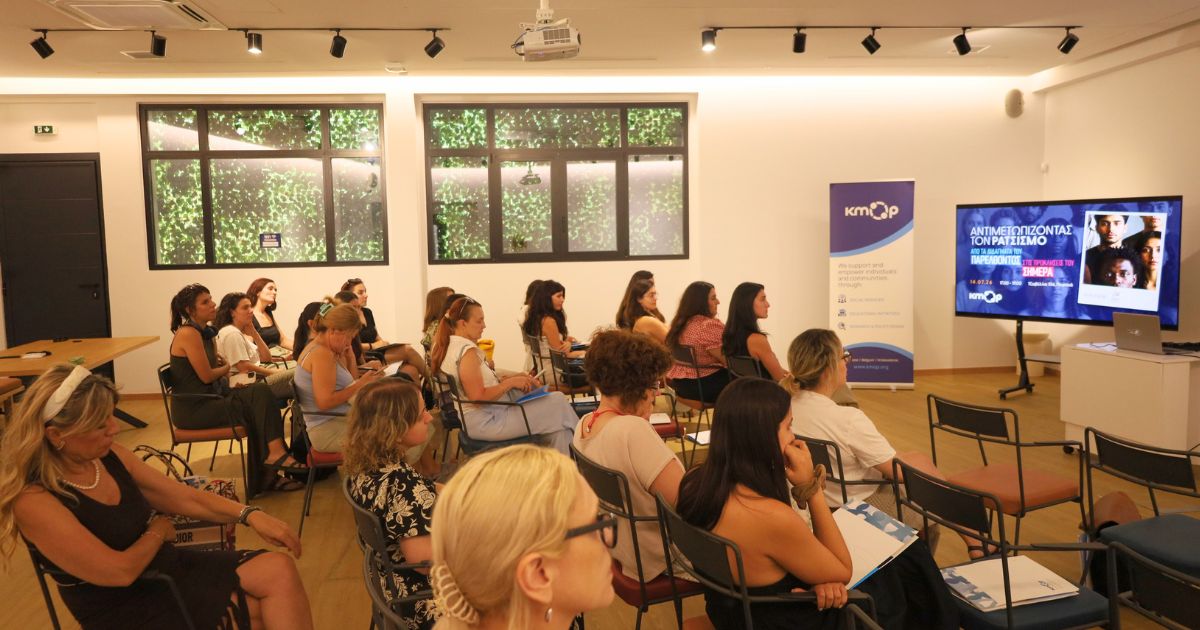
KMOP – Social Action and Innovation Centre held the event “Addressing Racism: From the Lessons of the Past to the Challenges of Today” on Tuesday, 14 July, in Piraeus, bringing together approximately 40 representatives of the educational community, policy makers, and civil society organisations, as well as young people.
The event highlighted remembrance as an essential tool for education, critical thinking and the tackling racism. Knowledge and understanding of historical experiences of discrimination, persecution and social exclusion help us identify their contemporary manifestations at an early stage, challenge stereotypes and prejudice, and prevent the injustices of the past from being repeated. At the same time, the event created a space for meaningful dialogue and active participation, encouraging the exchange of experiences and the development of collective proposals for fairer, more democratic and inclusive societies.
The event was opened by Nefeli Papagiannakou, Senior Project Manager at KMOP, and Angela Skempi, Project Manager at KMOP, who presented the initiative’s objectives and the importance of historical memory as a tool for preventing racism and discrimination.
Introductory contributions were delivered by Kostis Kornetis, Principal Researcher at the Institute of Historical Research of the National Hellenic Research Foundation and an adviser to the Spanish Government on historical memory, and Margarita Markoviti, PhD, political scientist and Senior Research at KMOP.
In addition, Marianna Zervogiorgi and Fiorinta Tsenai, cultural managers at CULTTERRA, presented initiatives being implemented in Elefsina to empower the local community through cultural activities.
The second part of the event featured two parallel participatory workshops, during which participants worked in groups on specific case studies and experiential scenarios concerning contemporary manifestations of antisemitism, racism and social exclusion. By analysing real and hypothetical incidents, they were invited to identify the root causes and consequences of discrimination, consider possible interventions, and develop concrete policy recommendations for its prevention and more effective response.
The workshops encouraged active participation, the exchange of experiences and good practices, and the collaborative development of proposals. Particular emphasis was placed on strengthening education on historical memory and human rights, fostering critical thinking, and building synergies among educational institutions, civil society organisations, local authorities and communities.
The dialogue and meaningful contributions of the participants confirmed the need for more initiatives that connect the lessons of the past with contemporary social challenges and turn knowledge into concrete action. The proposals developed during the workshops will be consolidated and used to formulate practical policy recommendations aimed at establishing historical memory as a key means of preventing and combating racism, promoting respect for diversity, and strengthening democratic participation and social cohesion.
For further information, please contact us at [email protected].