
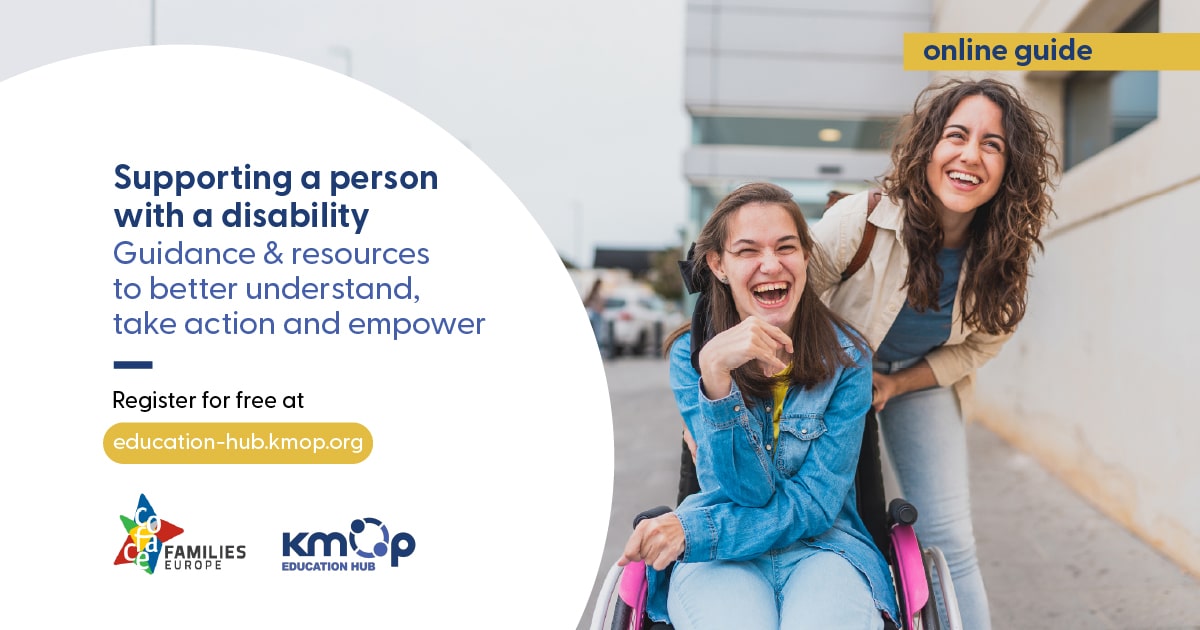
Supporting a relative with a disability. Understand your role. Find support. Take action.
To celebrate United Nations’ International Day of Care and Support, COFACE Families Europe and the KMOP Education Hub are pleased to launch a new free guide for family carers of persons with disabilities. The guide brings together practical information, resources and guidance to help family carers better understand their role, navigate everyday challenges and find ways to support the wellbeing and inclusion of the person they care for, as well as their own wellbeing. It is available in English, French, Greek and Italian.
Are you a family carer or a professional working with families of persons with disabilities?
Family carers play a vital role in supporting persons with disabilities. Yet, caring responsibilities can also bring challenges, from navigating services and support systems to balancing care with work, family life and personal life.
This guide has been co-created with the COFACE Disability platform to provide family carers with practical information and help them feel better informed and supported. It is designed as a resource that carers can explore at their own pace.
Whether you are a family carer looking for practical information, a relative or a friend supporting someone who provides care, or a professional working alongside families, the guide offers useful insights and resources to help strengthen support for family carers.
What can be useful for you in this guide?
By the end of the guide, you may realise that you can:
• Build an understanding of how disability interacts with the environment;
• Recognise some of the key competences and skills you have developed through providing support;
• Feel empowered to care for yourself while also taking care of your relative;
• Recognise the value of peer support and community networks for family carers.
Explore the guide and find support that works for you
Whether you are new to caring or have been supporting a family member for several years, this guide is here to help you navigate some of the questions and challenges that you may face: from better understanding disability and recognising your competences, to navigating self-care and engaging with the community.
Explore the guide, discover useful information and resources, and find practical support.
About the guide
Duration: It will take you approximately 2 hours to read the whole guide. You do not have to read it in one go and you can just focus on the sections that feel the most relevant right now.
How does it work?
You can:
– Read the PDF guide here.
– Find the interactive version of the guide here.
Language: The PDF guide is available in English, Greek, Italian and French. The interactive version is available in English.
Free: The guide is free of charge.
Who developed the guide?
The guide was developed by Dr. Antonia Torrens, General Manager of KMOP and President of COFACE Families Europe, and Zoé Lardou, Education programme coordinator at COFACE Families Europe.
It was co-created with family carers and professionals of the COFACE Disability platform.
Here is what some of the co-creators of the guide have to say about it
Antonia Torrens, Director of KMOP and President of COFACE Families Europe:
We considered it important to begin this guide by exploring the different meanings that disability can take for different people. This is more than a starting point: it is a fundamental precondition for understanding disability and for deciding how to act as a carer. By recognising the person beyond their disability, carers can better prioritise their actions and focus on what truly empowers the person with a disability, – their autonomy, dignity, participation and right to make choices about their own life.
Chantal Bruno, Co-chair of COFACE Disability:
Supporting a relative with a disability is a commitment. Whether it’s a daily or one-off task, it always requires time, energy, skills and a great deal of adaptability. But it’s like getting on a train without knowing where it’s going. Many people, like you, find themselves in this role without having been prepared for it. This guide is here to help you better understand this journey: how you end up on this train, what it involves, what it changes, and what you can make of it.
For further information, contact us at [email protected].