
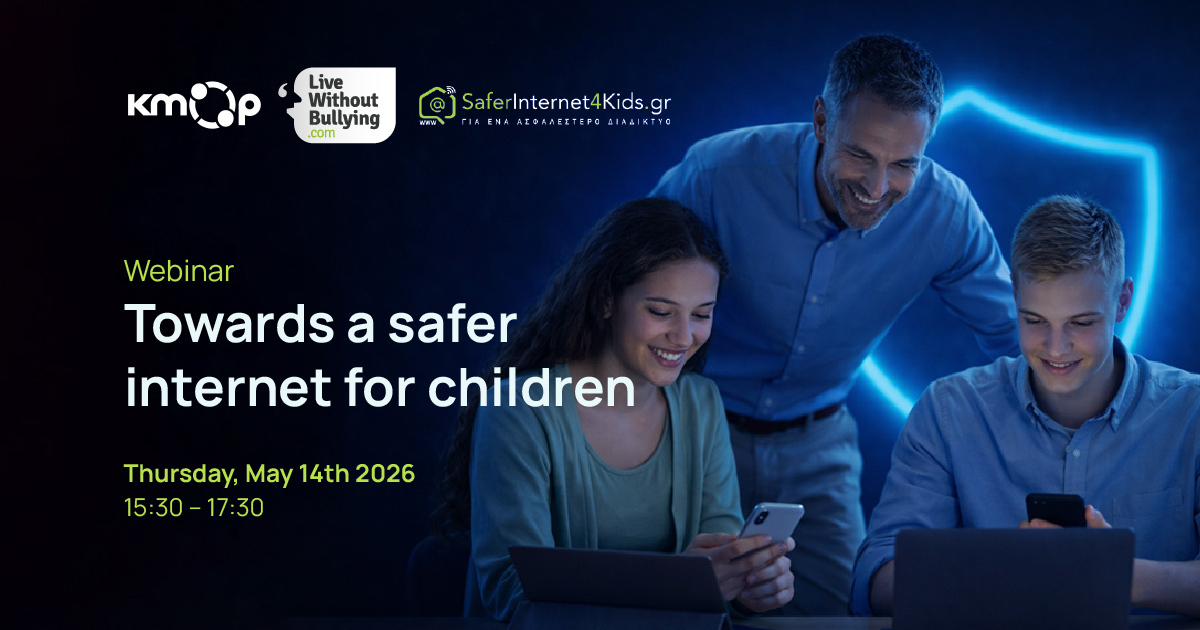
At a time when 92% of European citizens consider the online protection of minors a highly important issue, more than 700 parents and educators actively participated in the seminar “Towards a safer internet for children” organised by KMOP through Live Without Bullying and the Hellenic Safer Internet Centre of FORTH on Thursday, 14 May 2026.
The discussion focused on the contemporary challenges children and adolescents face online and highlighted the importance of prevention, critical thinking and the active involvement of parents and educators in shaping a safe and healthy digital culture.
Algorithms, deepfakes and children’s mental health
Dr Antonia Torrens, Educational Psychologist, General Director of KMOP, President of the Confederation of Family Organisations of Europe (COFACE Families Europe) and creator of Live Without Bullying, analysed the psychological and social impact of children’s and adolescents’ excessive exposure to social media. She stressed that algorithms reinforce the need for constant validation through likes and comments, affecting young people’s self-esteem and mental health.
She also referred to the “culture of constant comparison” promoted on social media, as well as to the new challenges created by artificial intelligence, such as deepfakes and the growing difficulty of distinguishing between real and fake content.
At the same time, she underlined the positive potential of the internet, including access to knowledge, creativity, communication and the development of digital skills.
Gaming Disorder: Warning signs parents should not ignore
Angeliki Oikonomopoulou, Systemic Psychologist MSc and Coordinator of KMOP’s “Ariadni” Day Centre, focused on the addictive dimension of gaming and the psychological and social aspects of children’s and adolescents’ excessive engagement with video games.
As she explained, the World Health Organization has already recognised Gaming Disorder as a mental health condition. She presented key signs of addiction, including loss of control, neglect of everyday activities and continued use despite negative consequences.
Ms Oikonomopoulou also noted that many children use gaming as an escape mechanism from feelings of anxiety, loneliness or rejection. She encouraged parents and caregivers to strengthen communication with children and establish balanced rules regarding internet use. In parallel, she referred to Serge Tisseron’s “3-6-9-12” rule, that recommends gradual and age-appropriate exposure of children to screens, social media and the internet.
New rules for the online protection of minors
Dr Paraskevi Fragkopoulou, Coordinator of the Hellenic Safer Internet Centre of FORTH, presented the new European regulations aimed at protecting minors online, placing particular emphasis on age-verification mechanisms for access to social media.
As she explained, from 1 January 2027 Greece will prohibit children under the age of 15 from accessing social media through special age-verification tools using digital identities and QR codes.
She also stressed that responsibility for children’s online protection does not lie solely with parents and educators, but also with the platforms themselves, which are now expected to design services with minors’ safety in mind. She referred to parental control tools and access restrictions already implemented by platforms such as YouTube and Roblox, while highlighting the importance of raising awareness among both parents and children regarding digital safety and responsible internet use.
More information about the initiatives of the Hellenic Safer Internet Centre is available at SaferInternet4Kids.
Jenny Lazarou, Institutional and Community Engagement Coordinator moderated the discussion.
The seminar highlighted the need for continuous awareness and collective action in addressing the challenges of the digital era, with the aim of creating a safer, more supportive and more creative online environment for every child. The message was clear: children deserve a digital world where they can grow up freely, safely and protected.
For further information, please contact [email protected] or call +30 210 3637547.