
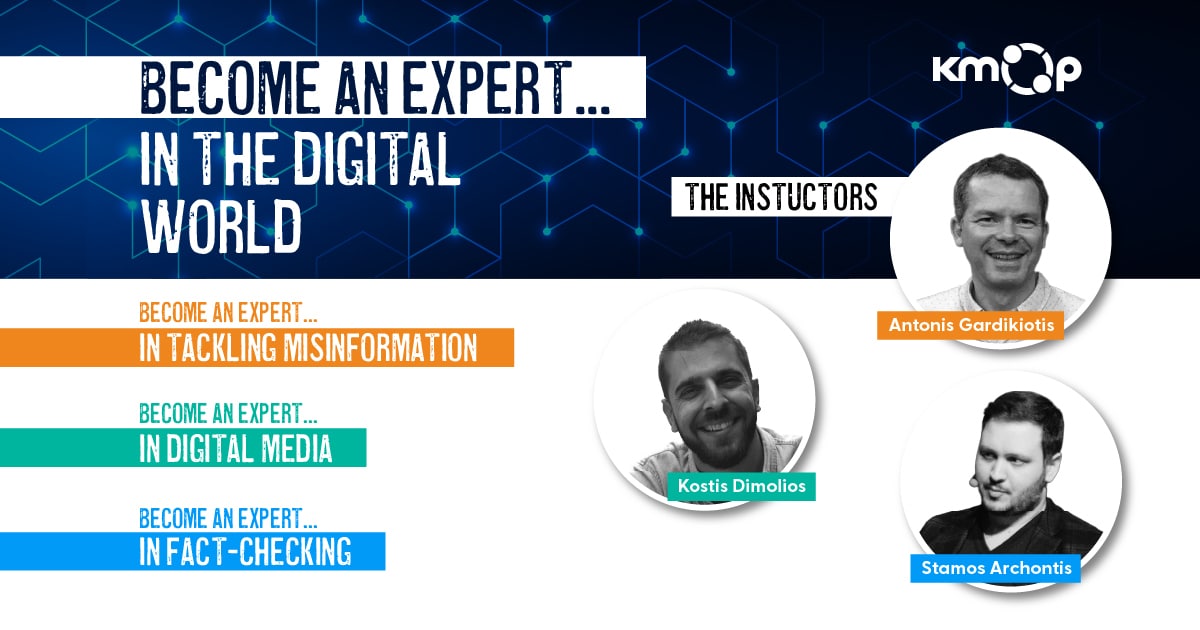
At a time when misinformation and digital noise undermine the quality of democracy and everyday life, KMOP trained more than 800 participants in the critical use of digital media through the seminar series “Become an expert in the digital world.”
The series took place on 12, 19 and 26 February 2026 and included three online seminars featuring academics, journalists, educators and professional fact-checkers. KMOP equipped participants with practical tools to navigate the internet safely, address digital risks and manage online media effectively and with confidence.
The first seminar featured Antonis Gardikiotis, Professor of Social Psychology and Media at the School of Journalism and Mass Communications of the Aristotle University of Thessaloniki. Participants explored the critical issue of misinformation in depth.
“I truly appreciated the opportunity to discuss misinformation. We live in an era where empowering media users is essential, and this seminar provided that opportunity to all participants,” he noted.
Kostis Dimolios, educator and founder of Media Owl, delivered the second seminar. He examined the algorithm-driven world of digital platforms, the way applications function and our relationship with digital devices. He presented practical ways to regain control of daily digital habits and to cultivate a more conscious and critical approach to media use.
“The interaction with participants reminded me how essential it is to create opportunities for information, learning and exchange. In today’s digital age, the way we consume and interpret the constant flow of information shapes the very quality of our lives and our democracy. In a world filled with misinformation, discussing, informing and educating ourselves about how media operate is not a luxury but a necessity,” he stated.
In the third seminar, Stamos Archontis, journalist and professional fact-checker, co-founder and editor-in-chief of FactReview, presented the potential as well as the limitations of professional misinformation analysis. He also introduced key fact-checking tools that can be used in everyday practice and explored the role of artificial intelligence in both combating and spreading false information.
Strengthen Your Digital Literacy
Register on the educators’ platform here.
What will you learn?
- Identify misinformation and understand how it spreads: explore how cognitive biases, propaganda and populist rhetoric operate in today’s digital environment and how they influence students and educators.
- Foster media literacy in the classroom: apply practical critical-thinking tools, source and data analysis techniques, and pre-bunking strategies to prevent misinformation.
- Implement pedagogical and community-based responses: use activities, case studies and collaborative models that empower students to become active, informed and responsible digital citizens.
The seminar series formed part of the MILES project, through which KMOP works to counter misinformation and promote media literacy.
For further information, please contact KMOP at [email protected] or call +30 210 3637547.