
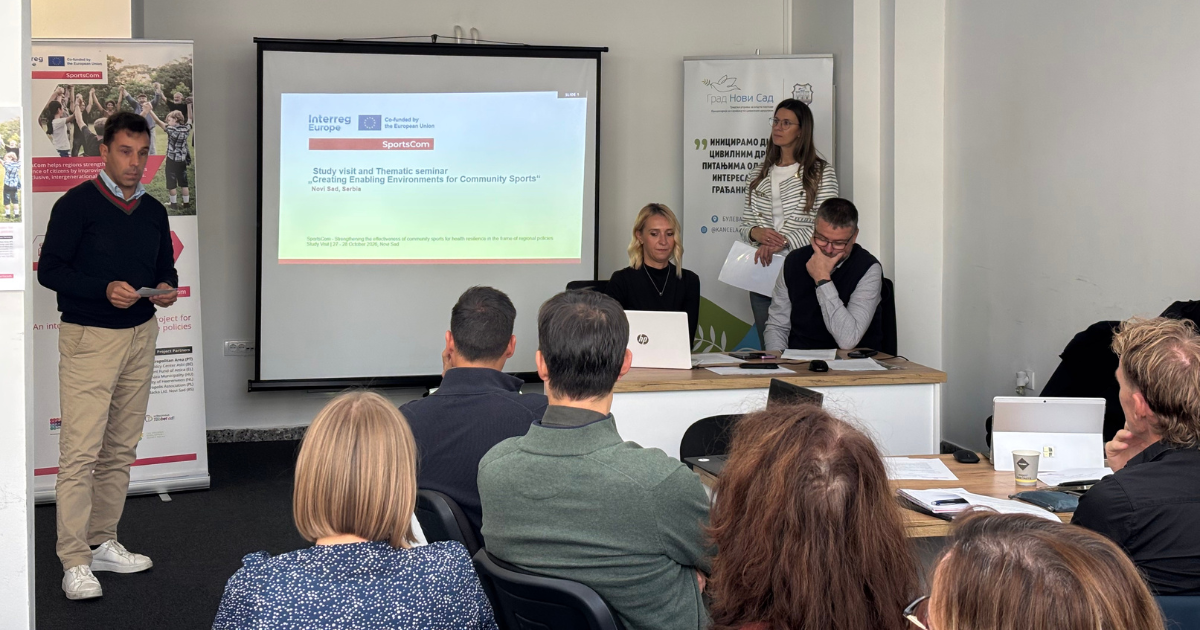
KMOP and European regions explored how accessible public spaces, inclusive programmes and local partnerships can encourage more people to take part in sport and physical activity.
How can cities make sport accessible to everyone, regardless of age, ability or income? Beyond investing in new sports facilities, local authorities need to consider how people access and use public spaces in their everyday lives.
On 27–28 October 2026, KMOP joined representatives from European regions and sports stakeholders in Novi Sad, Serbia, for a two-day study visit organised by the Regional Development Agency to explore practical ways to make community sport more accessible and inclusive.
Participants examined how affordability, safety, proximity and organised activities influence participation in sport, while exchanging good practices from across Europe.
European good practices for inclusive community sport
During the visit, we discovered initiatives taking place in different countries and regions that demonstrate how cities and regions can encourage physical activity and remove barriers to participation.
- Serbia: Novi Sad demonstrated how the renewed Danube Quay, Limanski Park and free City Day activities encourage residents to stay active.
- Portugal: Espinho presented its free adapted sports programme for children and young people with disabilities, while Matosinhos highlighted a free exercise prescription and nutritional counselling service that has delivered over 17,000 consultations since 2019.
- Greece: The Region of Attica demonstrated how social data and deprivation mapping can help authorities direct sports programmes towards underserved neighbourhoods.
- Poland: Zabierzów showcased school sports competitions involving more than 4,500 pupils, promoting physical health, friendships and self-esteem.
- The Netherlands: Heerenveen presented its vision for 2030, combining green schoolyards, accessible public sports spaces and a dedicated City of Sport campus.
- Hungary: Nyíregyháza highlighted its network of 29 free outdoor fitness parks and more than 80 kilometres of cycle paths.
What makes community sport accessible to everyone?
The study visit concluded with discussions on how European regions can adapt successful approaches to their local contexts. Participants identified several priorities: providing free and safe sports spaces close to residential areas, maintaining facilities and organising regular activities, strengthening cooperation between local authorities and community organisations, and using participation data to identify underserved groups.
A central conclusion emerged: making sport part of everyday life requires more than infrastructure. Cities also need inclusive programmes, accessible public spaces and partnerships that respond to the needs of their communities.
The study visit was part of the SportsCom project, through which KMOP works with European partners to exchange good practices and inform regional policies that promote inclusive participation in sport and physical activity.
For further information, contact us at [email protected].