
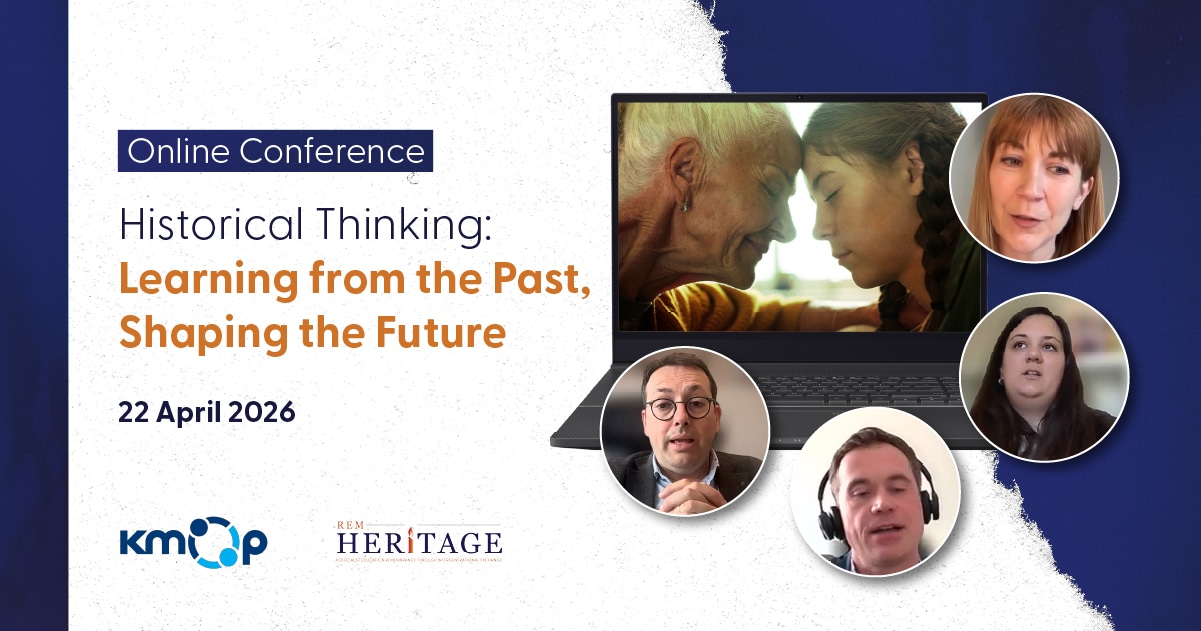
On Wednesday, April 22, 2026, KMOP – Social Action and Innovation Centre successfully hosted the online conference titled “Historical Thinking: Learning from the Past, Shaping the Future.”
The event brought together more than 160 people, from across Europe, representing the fields of education and civil society, confirming strong interest in promoting historical thinking as a tool for fostering democratic values, critical thinking, and active citizenship among younger generations. Particular emphasis is placed on interdisciplinary learning and on the role of education in promoting tolerance and human rights.
The REM HERITAGE initiative was also presented, promoting a more participatory and inclusive approach to historical learning, in connection with contemporary social challenges.
Distinguished speakers from the academic, research, and social sectors contributed to the conference, sharing knowledge, experiences, and best practices.
In her opening remarks, Dr. Margarita Markoviti, Professor of Political Science at Deree – The American College of Greece and Senior Researcher at KMOP, highlighted the urgent need for new forms of historical memory at a time marked by the rise of antisemitism and the passing of the last Holocaust survivors. She presented findings from the REM Heritage workshops, noting that many young participants encountered Greece’s tragic history for the first time and were able to recognize the consequences of dehumanization in today’s forms of discrimination.
Dr. Antonis Klapsis, Vice President of KMOP and Associate Professor at the University of the Peloponnese, focused on the role of historical knowledge in modern democracy. He emphasized that history serves as a tool for self-awareness and understanding the present. In the school context, he stressed, the goal is not memorization, but the cultivation of students’ critical thinking and their analytical and synthetic skills.
Nefeli Papagiannakou, Senior Project Manager at KMOP, presented the REM HERITAGE initiative as a dynamic framework for dialogue and exchange of experiences aimed at preserving historical memory at the European level. She highlighted how understanding the past can serve as a foundation for shaping the future.
The presentation also showcased the project’s key activities, including workshops engaging hundreds of young people, the development of digital storytelling initiatives, the creation of a Youth Ambassadors network, and the development of a digital platform designed as a space for sharing experiences and memory among young people across Europe.
Dr. Artur Niedźwiecki, Dean of the Faculty of Political Science at the Academy of Humanities and Economics in Lodz (AHE), emphasized the importance of political education in shaping active citizens. He focused extensively on Holocaust education, particularly in the Polish context, stressing that it represents a deeply rooted historical experience in Europe’s collective memory. He underlined that such a tragedy did not arise abruptly, but resulted from gradual social, political, and ideological developments that fostered exclusion, antisemitism, and violence.
He also highlighted the growing risks of the instrumentalization of history and historical amnesia, both of which weaken collective memory and may lead to the repetition of past mistakes.
The conference served as an important platform for dialogue and knowledge exchange, reinforcing the need to strengthen initiatives that promote democratic culture, collective memory, and inclusive education.
REM Heritage at a Glance
REM Heritage is a transnational initiative funded by the European Commission’s CERV programme, implemented in collaboration with partners from Belgium, Greece, Cyprus, and Poland.
For more information, please contact us at [email protected].